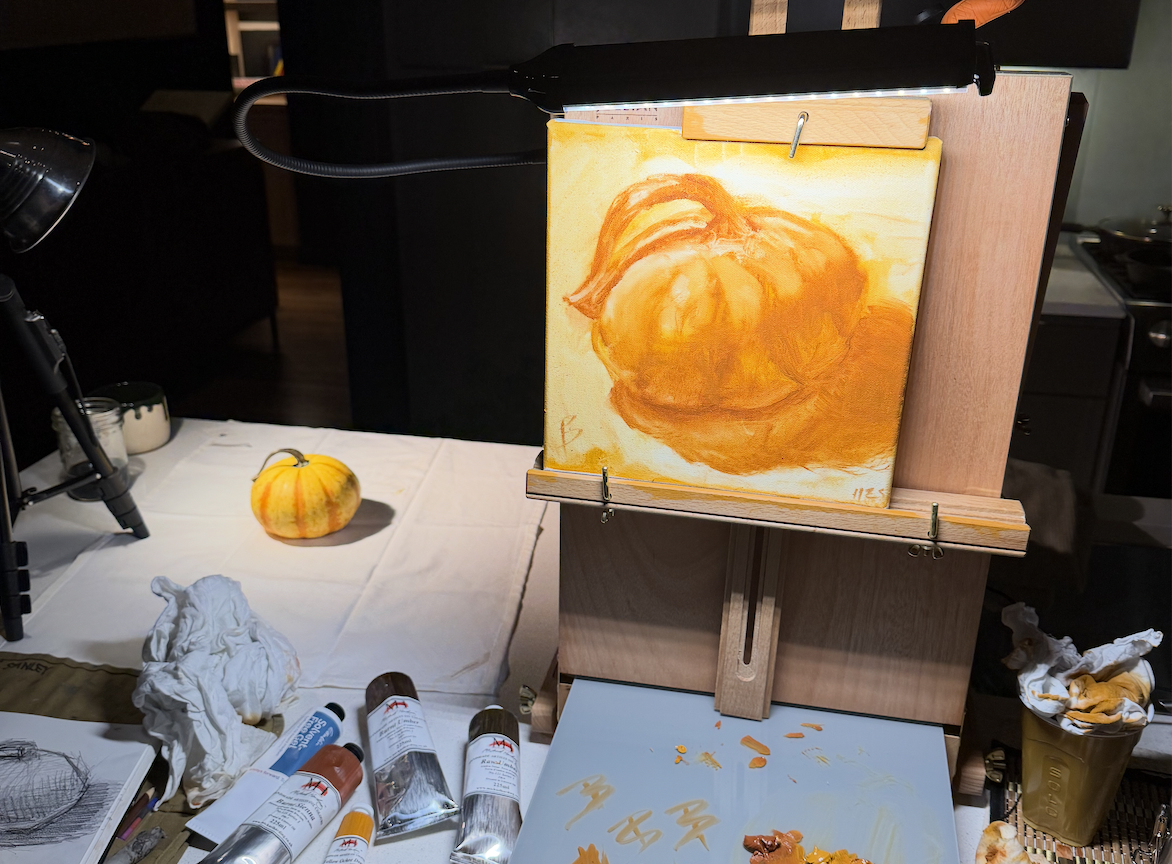
When I think about a shadow I used to think of a dark mirror image of whatever item is being hit with the sun or a light. Like a fall tree for example; the shadow appears to be the black and white copy of a illuminated tree with orange and yellow leaves, standing in the sun. But a shadow actually isn’t the black and white version of anything at all - in fact it brings out its own colors, outlines and uniqueness that adds to whatever item you’re focusing on.
I’ve recently started focusing on the shadows because, I started painting again. I grew up in an small town in southern New Hampshire with an incredible art community. Think Hallmark movie - a small town square, the quintessential white steeple church, old stone and brick buildings, with a flowing river running through the middle of it - that’s Peterborough. My parents always made sure my sister and I were involved in a number of activities - sports and the arts. That’s when I started learning how to paint. It wasn’t a passion of mine by any means, I was definitely more into spots; like softball and running, but I remember loving the ability to create. I think the last time I painted anything besides walls in my home I was in middle school - taking an art class with friends - but in the craziness of this adult life I’ve been looking for a way to slow down and stop staring at my phone - and let my mind create.
I was gifted an easel, painting supplies and painting classes in October for my birthday. Finally something to get my butt into gear and actually start painting. My classes are with a local painter named Kymberlee, she paints stunning landscapes around the world and truly has an eye for all the vibrant colors. She's one of those artists whose art looks like it could have been the actual photograph. She came over to my home for the first time in late October. It was a chilly evening, already dark since the sun sets at 4:00 this time of year. She’s a bubbly personality, with glasses and fun fashion. She came in and made herself at home in our kitchen - setting up her easel and mine, and going through all the supplies I had - explaining how each one helps in the painting process, and what paints are the most important to have on hand for any painting.
Our first painting subject; a pumpkin - just a small yellow and orange striped pumpkin from the stack on my front porch. One so small it can fit in the palm of your hand - with a curved stem almost making it look like a teapot. Kymberlee placed it on a white tablecloth on the counter and put a spotlight on it.
When she asked me how I would paint this - my initial reaction was get some orange, yellow and black paint out and go from lightest to darkest - but man was I wrong. Sure, we need some orange and yellow because well... that’s the color of the pumpkin - but Kimberly made me really study the shadows - squint, step back and study the shadow figure on the white tapestry.
When you really looked at the shadow of the pumpkin - you could see the orange glow that warmed up the dark areas of the shadow, stronger areas of deep color where the pumpkin really masked any light from reaching it, hot spots where the light dipped over the pumpkin and finally got its full brightness onto the cloth, and then you could see where the sharpness of the shadow edge started to blur the further from the light source you got. What I thought was just the black and white copy of the pumpkin - was actually it’s own beautiful figure with its own shapes and colors.
It was the part of the painting lesson that stood out the most. I wanted to paint again to slow down. and take my mind off of work and the busyness of life around me - but my initial reaction was just to see the most efficient way I thought to paint the image in front of me. The real fun is in slowing it down - it's in blending the colors until you get the right shade for each shadow area, smudging the paint onto the canvas in certain place with your fingers to get the blurred look around the edges, stepping back when you found yourself spending too much time close to the canvas - to get the big picture view - and go back to the details. It's about seeing the item and its shadows, for everything that it is, and all the colors it shows.